About Pyrs
Frequently Asked Questions at the Rescue
1. WHERE CAN I SEE THE PYRS AVAILABLE FOR ADOPTION? We list all of the available dogs in one place on our web page: http://carolinapyrrescue.com/available-dogs/ This list is always accurate and up-to-date.
2. I WANT TO ADOPT A PYR. WHAT SHOULD I DO? Start by reading our policies, which we’ve posted on our web page: http://carolinapyrrescue.com/adoption-policies/
3. DO I REALLY NEED A SOLID AND SECURELY FENCED YARD? CGPR adopts only to homes with a secure wood or metal fence that is at least four feet tall. Some dogs, particularly those we know to be jumpers and climbers, require taller fences and are rehomed only to those who can provide them. To learn more, click here: http://carolinapyrrescue.com/why-fences-arent-negotiable/
4. WHERE CAN I FIND YOUR APPLICATION? http://carolinapyrrescue.com/adoption-application/
5. CAN I JUST COME TO THE KENNELS? Because we are based out of a private business and are an all-volunteer organization, we aren’t available for walk-ins. We meet with approved applicants by appointment between Tues. and Sat. from 7 am until 5 pm. Most approved applicants adopt a dog within a week to ten days of submitting their materials.
6. I DON’T LIVE IN NORTH OR SOUTH CAROLINA. CAN I ADOPT FROM YOUR RESCUE? We believe that we make the best possible matches by requiring applicants to come meet the Pyrs in person at our kennels in Indian Trail, NC before making a commitment to adopt any particular dog. This is why we do not allow commercial transport, friends, or family to pick up dogs for adopters. We do not make exceptions. Whenever possible (and we understand that it isn’t always possible), we also suggest bringing current dogs to these meetings because fur family members often make or break the adoption. Should an adoption fail, we expect families to return the Pyr to us, and our contract specifies this. For these reasons, we invite anyone who lives within a day’s drive of Charlotte, NC to adopt from the rescue. We encourage those who live farther away to adopt locally.
7. I AM HAVING TROUBLE ACCESSING YOUR WEB PAGE/ONLINE APPLICATION. CAN YOU HELP? Yes! Email webmaster@carolinapyrrescue.com.
8. I WANT TO LEARN MORE ABOUT PYRS. CAN WE TALK? We receive dozens of phone calls each week, and we have to focus on those calls coming from shelters throughout the Carolinas and from those who adopted from us. We wish we had the resources to provide behavior consultation to all those who purchased Pyrs from breeders or who reach out to us from across the US, but we simply do not have the available volunteer hours to do so. We have provided many useful articles under the RESOURCES tab on our web page, and we suggest that people consult the Great Pyrenees Club of America’s page on training Pyrs for useful links and book titles: http://gpcaonline.org/obedience.htm For many people, the best practices guide to helping your Pyr adjust (http://carolinapyrrescue.com/best-practices-successful-ado…/) and the instructions on crating (http://carolinapyrrescue.com/crate-new-pyr/) provide the information they are looking for.
9. CAN YOU TAKE IN PYRS FROM OTHER STATES? We focus our resources on Pyrs in North and South Carolina. We are glad to recommend reputable rescues to those who live in other states. The Great Pyrenees Club of America’s rescue contacts are a good place to start: http://gpcaonline.org/rescuecontacts.htm
10. DO YOU TAKE PYRS DIRECTLY FROM OWNERS? As of 7/21/18, we have pulled the owner surrender application from our web page. Why? Because we were receiving far more requests for help than we could accommodate, and we don’t want to give false hope or make promises we can’t keep in a reasonable time frame. We are almost always full caring for Pyrs from kill-shelters in our two-state region. We accept owner surrenders on a case-by-case basis as we are able to, and we almost always have a several month wait for a foster home or kennel. We are not a rehabilitation center for aggressive dogs, and we cannot take Pyrs who cannot safely interact with humans. We are caring for more Pyrs than we ever have (about 20 at a time) and are adopting out more Pyrs than we ever have (about a 150 a year), but there are simply not enough homes for Pyrs in the Carolinas. We wish we had the resources to take in all Pyrs in need immediately, but until one of us wins the lottery or gets a sugar mama or daddy, that’s not our reality. If you are willing to be the Pyrs’ sugar human, please email us!
11. I FOUND A PYR. WHAT SHOULD I DO? Contact animal control (AC), and keep in touch with us. AC will advise you of the requirements in your community enabling you to legally claim the dog or give the dog to a rescue. Most areas require a brief “stray hold,” meaning a dog has to remain in the region at a known location (the animal shelter or a private home) for several days should the owner be looking for the dog. We have good relationships with animal control officers across the Carolinas. Some people believe that if you call animal control, a dog will be euthanized immediately, but that’s simply not true except in rare cases. We take in the majority of our Pyrs by cooperating with AC. Only AC has the power to legally remove a dog from a property. We do not.
12. I WANT TO BREED. WILL YOU GIVE ME DOGS WHO HAVEN’T BEEN SPAYED OR NEUTERED? No. There are not enough homes for the Pyrs already alive in our region, which is why we exist. “Back yard breeders” who don’t health test their dogs or screen potential homes are the first domino in the chain of animal neglect and abandonment we see each day. We respect responsible and ethical breeding.
13. I DON’T WANT TO FOLLOW THE PROCEDURE YOU’VE LAID OUT. CAN I BULLY YOU INTO GIVING ME A DOG TO GET ME TO GO AWAY? No. The vast majority of people with whom we interact are wonderful. Occasionally, someone reaches out to us demanding we accommodate them in ways that aren’t consistent with the protocol we’ve set up over nearly thirty years of successfully rehoming several thousand Pyrs. First, we make the decisions we make because we believe they are in the best interests of the Pyrs. If we disappoint people, that’s not our intention, but we think first and foremost about the Pyrs’ welfare. Our policies, particularly our screening process, protect them. Second, we are volunteers. We don’t have to interact with anyone, and we’ve learned over the years that people who are mean to volunteers are also mean to dogs. Last, the people who run this rescue have skin thicker than Pyr fur. What hurts us? Having to say no to dogs we don’t have room to care for or humanely euthanizing a dog who is too sick to rehome. Swearing at us, threatening us, telling us how rescue organizations are the worst, we are only in it for the money (what money?!), etc. has exactly zero impact on us. We’ve heard it all and are still saving dogs and trying to do it better for all involved.
14. I NEED HELP COVERING THE COST OF MY PYR’S VET CARE. CAN YOU HELP? We understand that Pyr ownership is not cheap, but we aren’t able to pay for veterinary care except for Pyrs in our rescue. The following link provides information about charities that might be able to help: https://www.avma.org/public/YourVet/Pages/Financial-assistance-for-veterinary-care-costs.aspx
15. I WANT TO HELP. WHAT CAN I DO? Adopt a Pyr. Forever homes are our number one need. Donate. We sometimes request specific items the Pyrs need through our Amazon Wish List (search Carolina Great Pyrenees Rescue), but we always need cash donations. You can send checks made out to Carolina Great Pyrenees Rescue to CGPR, P.O. Box 504, Marshville, NC 28103, donate via PayPal (search paypal@carolinapyrrescue.com), or give on Facebook by clicking on the blue DONATE! button. Sharing and liking out Pyrs’ pictures and videos on social media also helps; more interaction from supporters puts our Pyrs in more peoples’ feeds.


¿IS A PYR FOR YOU?
 You’ve seen these big, beautiful white dogs and want one. The mature, sedate Pyr that you are drawn to did not just materialize suddenly. There is a great difference between a puppy and an adult and a considerable amount of time must pass as Pyrs are not mature until 3-4 years old. You will have to adapt as your dog grows from the thirty pound ball of fluff puppy you get at 3 months to the one hundred plus pound adult.
Pyrs combine a great intelligence and deep devotion to family and home with an instinct to guard and protect. While they are trustworthy, affectionate, gentle and loving, they also are protective guardians of their family and territory. Adult Pyrs are placid by nature and calm in the house, enjoying quiet periods in which to rest and sleep. They also want their life to be consistent and predictable. The addition of a dog to your family is a major decision and deserves a great deal of time, research, and thought. While with routine grooming they are not much different than other breeds, they do shed and there are white hairs in Pyr homes, cars, and on Pyr owners and visitors.
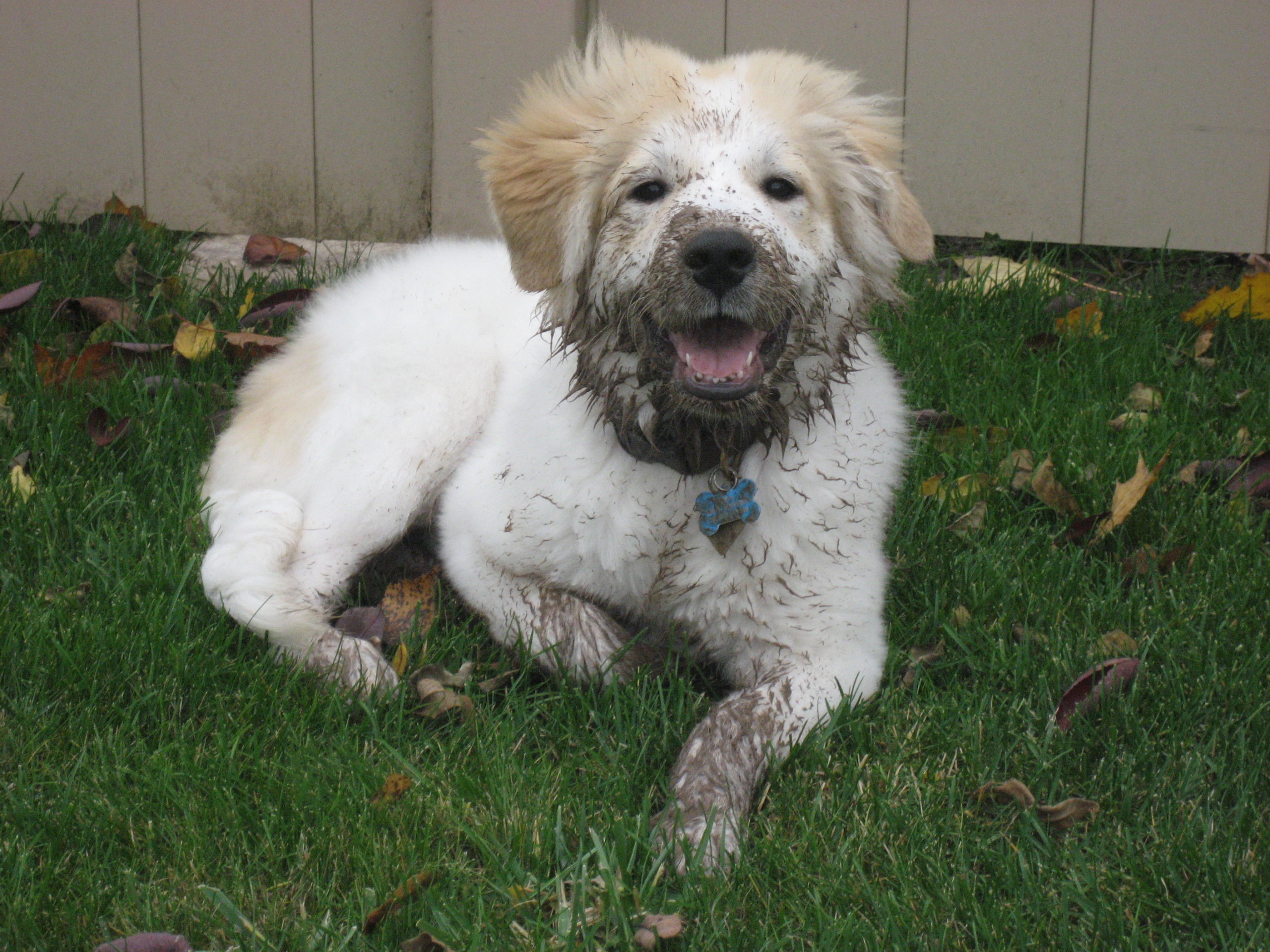 A Pyr needs love and attention on a daily basis. Their basic personality is different from most breeds. Most breeds were bred to take commands from people; Pyrs were bred to work on their own. A Pyr is an intelligent, sometimes willful animal. They have minds of their own and are not easily obedience trained. If you want a dog who will be a good “off leash” companion for your outside activities and follow your every command, the Pyr is not for you. They are large and must be confined in a secure fenced area or they will patrol a large territory—as large as your neighborhood. When out of the fence they must be kept on lead at all times. Pyrs are barkers, especially at night if left outside. Most Pyrs in urban and suburban settings are “inside” family members.
¿ARE YOU READY TO ADOPT?
The first step to adopting one of our Pyrs is to read our policies and fill out an application here on our webpage. Approved applicants are invited to meet the Pyrs by appointment only.
By Theresa Granito
 There are a lot of really good reasons to adopt an adult/senior dog of any breed. A quick search on the web for “advantages of adopting a senior dog” will result in an impressive list of sites. Almost all will list and expound on the positives. Here’s my top 5:
1 Almost no need to potty train;
2 They’ve been exposed to families and are already socialized to some degree;
3 They’re easier to train (they focus better and longer);
4 They’re no longer destructive around the house. You can leave your shoes by the couch and, usually, little Mary’s favorite plush toy is safe on the bed;
5 What you see is what you get; most often, there will be minimal change in color or size.
While all this sounds great, is it true of a Great Pyrenees? Great Pyrs are, after all, large dogs; large guardian dogs, at that. Usually, a big dog that’s five years old or older doesn’t have too many more years left, right?
 It has been my experience that a five to seven year old Pyr isn’t really a senior but rather an adult. We’ve been owned by several Pyrs and know that barring any major health issues, a Pyr living into their teens is not uncommon. Our original crew didn’t slow down until they were about eight years old. At that age they were willing to let the young ones do more of the “work” while they supervised from their favorite surveillance spot in the yard. But they were still out there night after night patrolling the fence teaching the newbies the ropes. They got in and out of the car, up on the couch or bed, loved their walks and chased critters out of the yard.
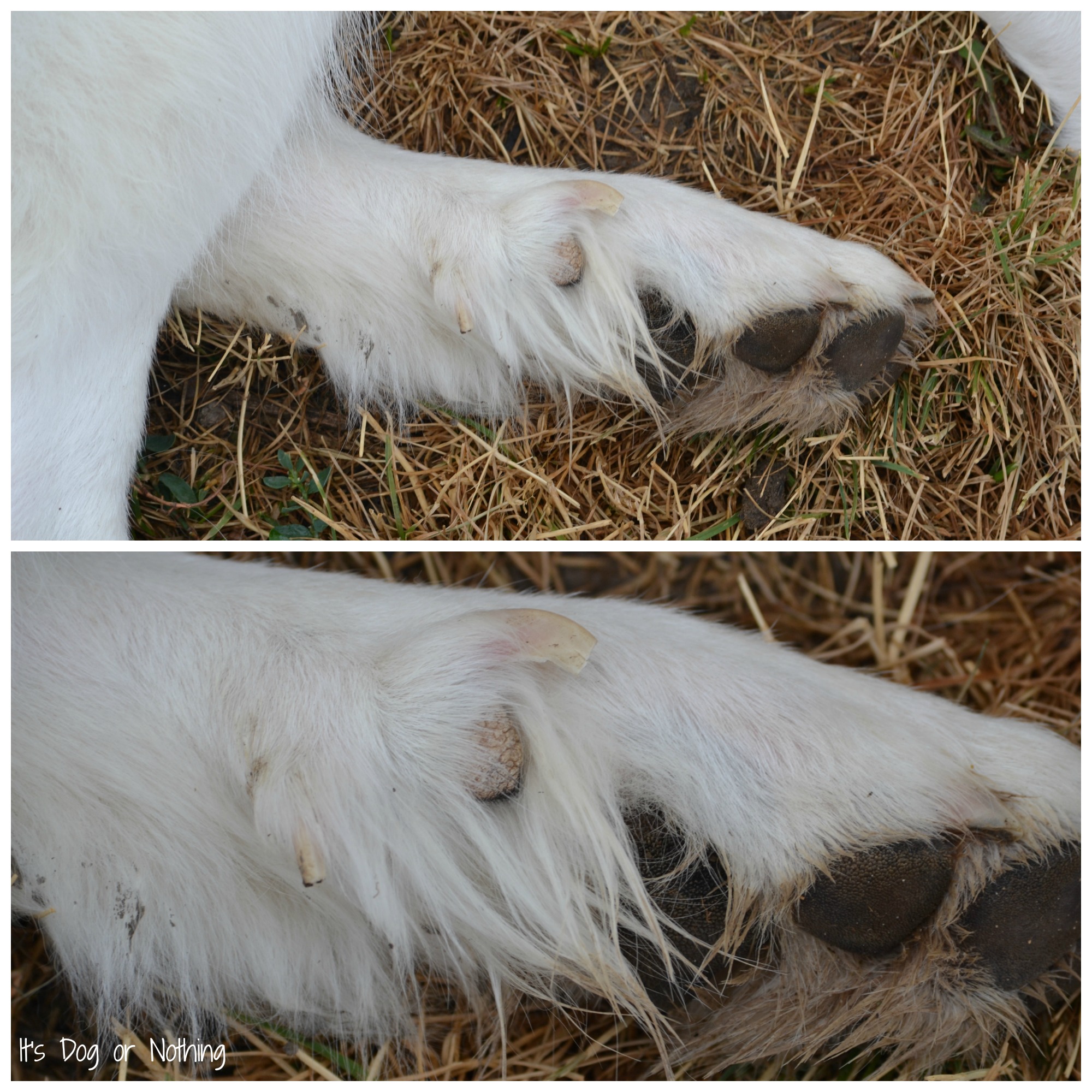
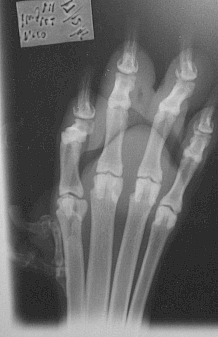
People unfamiliar with the breed often ask about Pyrs’ double dew claws. They notice the two nails on Pyrs’ hind legs that usually are surrounded by a cuff of fur. Double dew claws are toes with individual bone structure. They are a component of the breed standard of the Great Pyrenees in the United States (as established by the Great Pyrenees Club of America) and a distinguishing feature of the breed around the world.
These toes and their connecting tendons stabilize the foot. In the past, when Pyrs were primarily working dogs in mountains, they provided traction and enabled stability.
Double dew claws are neither defects nor problems, and they should never be removed. To be clear, removal of double dews is amputation requiring the surgical cutting away of bones, tendons, and nerves. It serves no purpose and can result in biomechanical problems of the foot as Pyrs age, particularly when the amputation is performed on young dogs before they have finished growing.
Caring for double dew claws is simple: keep them trimmed. Nails that are not left long enough to hook cannot get caught on anything. Read even more information at this link to Pawversity.
by Catherine de la Cruz of Poste de Pompier Working Great Pyrenees
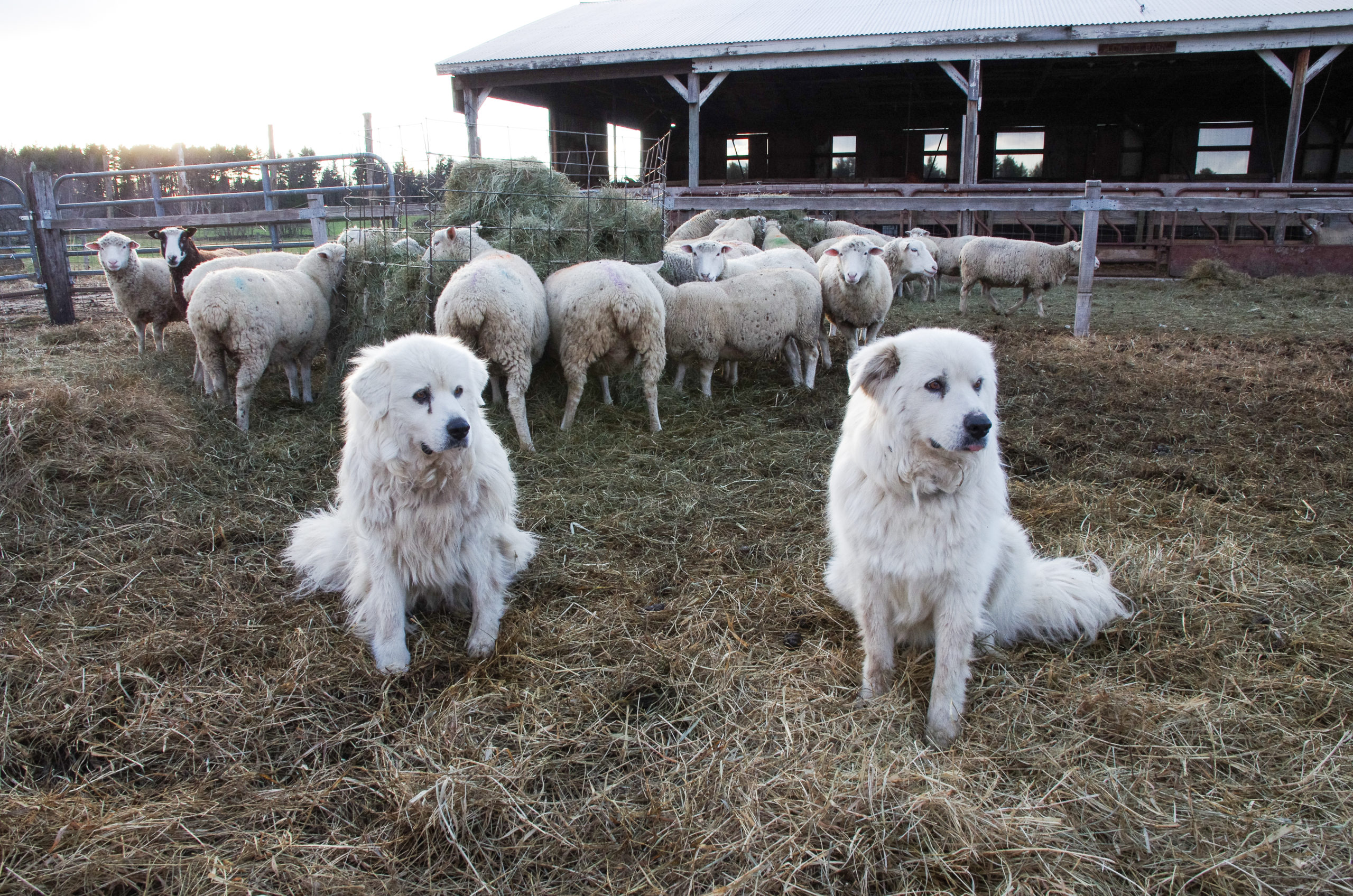 The original purpose of the Anatolian, Kommondor, Kuvasz, Maremma, Pyr and similar breeds was to protect livestock from predators. The Livestock Guardian Dogs (LGDs) share some common traits: they are about the same size and color as the livestock they were bred to guard; they exhibit the traits of “responsibility” (the tendency to remain with the livestock) and “reportability” (regular checking-in with the human caretaker of the flock.) There are many more similarities among the LGD breeds than there are differences between them. Some breeds, like Pyrs, were developed for tractability around people; others, like Tibetan Mastiffs, were developed for hostility toward those not of their camp – most LGDs fall somewhere in the middle.
For thousands of years, the economies of Europe and Asia alike were agricultural/pastoral. The LGDs were an essential part of the economy and dogs, like people, were judged solely on their ability to work. Then, 150 years ago, the Industrial Revolution began to change that; two World Wars and fifty years of “me-first” consumerism continued to change the face of the world inalterably.
With the exception of Australia and New Zealand, sheep populations world-wide have declined dramatically. It is no longer necessary for every family to own enough sheep to produce the wool for mother to spin and weave into clothing for the family. Cities have replaced farms, houses have replaced yurts and huts and the only predator that threatens the livelihood of most people is two-legged. In the United States, sheep production has been steadily declining since the 1940’s; there are now fewer that 10 million sheep in the entire country. Ninety percent of those are in the hands of 10% of the growers; the remaining one million sheep are found in backyard and family farm flocks of 50 or less. The situation is similar throughout Europe and Eurasia. In short, just as our own jobs are now different from that of our ancestors, and the skills needed for those jobs are different, so do our dogs have different jobs, requiring different skills than did their ancestors in the Old World.
In France, it was acceptable for the Great Pyrenees to wander the village during the winter when her sheep were stabled in the farm yard. When spring came she would follow her sheep to the mountains. The tendency to travel great distances that was originally a positive trait is a now liability in a country crossed with highways and heavy traffic. In Tibet, a stranger in the camp was usually up to no good and a Tibetan Mastiff that could pull down a man on horseback was highly valued. Such aggression in our society today would lead quickly to lawsuits and the destruction of the dog.
 So, the question of “transferrable skills” arises today as much for our dogs as for ourselves. An LGD needs “reliability” and “reportability” as much in his job as family watchdog as he does as a livestock guardian. What differs is his reaction to stimuli. The barking behavior that warns predators that something larger has staked a claim to territory becomes “problem” behavior when indulged on a city lot. The Mark-Warn-Chase-Attack sequence that serves to keep livestock safe from wolves must be truncated after the Warning behavior if the dog’s owners are to remain safe from charges of harboring a vicious dog. The sharp temperament that indicated a good working dog in the high mountains finds little place in a family whose members freely bring strangers to trespass the dog’s territory.
There are those in the business of raising LGDs who advocate “going back to nature”, “doing it like the Old Country” or “breeding only for `working ability.’” The reality is that we live in the time and the place that we do and few of our dogs will spend their lives wandering the unfenced range with their sheep. Even those of us who breed specifically for “working dogs” -i.e. dogs who will spend their entire life with the livestock, not interacting with families – recognize that, just as there are few “100% successful show” litters, so there are few “100% successful working” litters. I was once asked, during a Congressional hearing, whether I culled my guardian-dog litters, and what I did with the culls. Tongue-in-cheek, I replied, “I sell them as show dogs.”
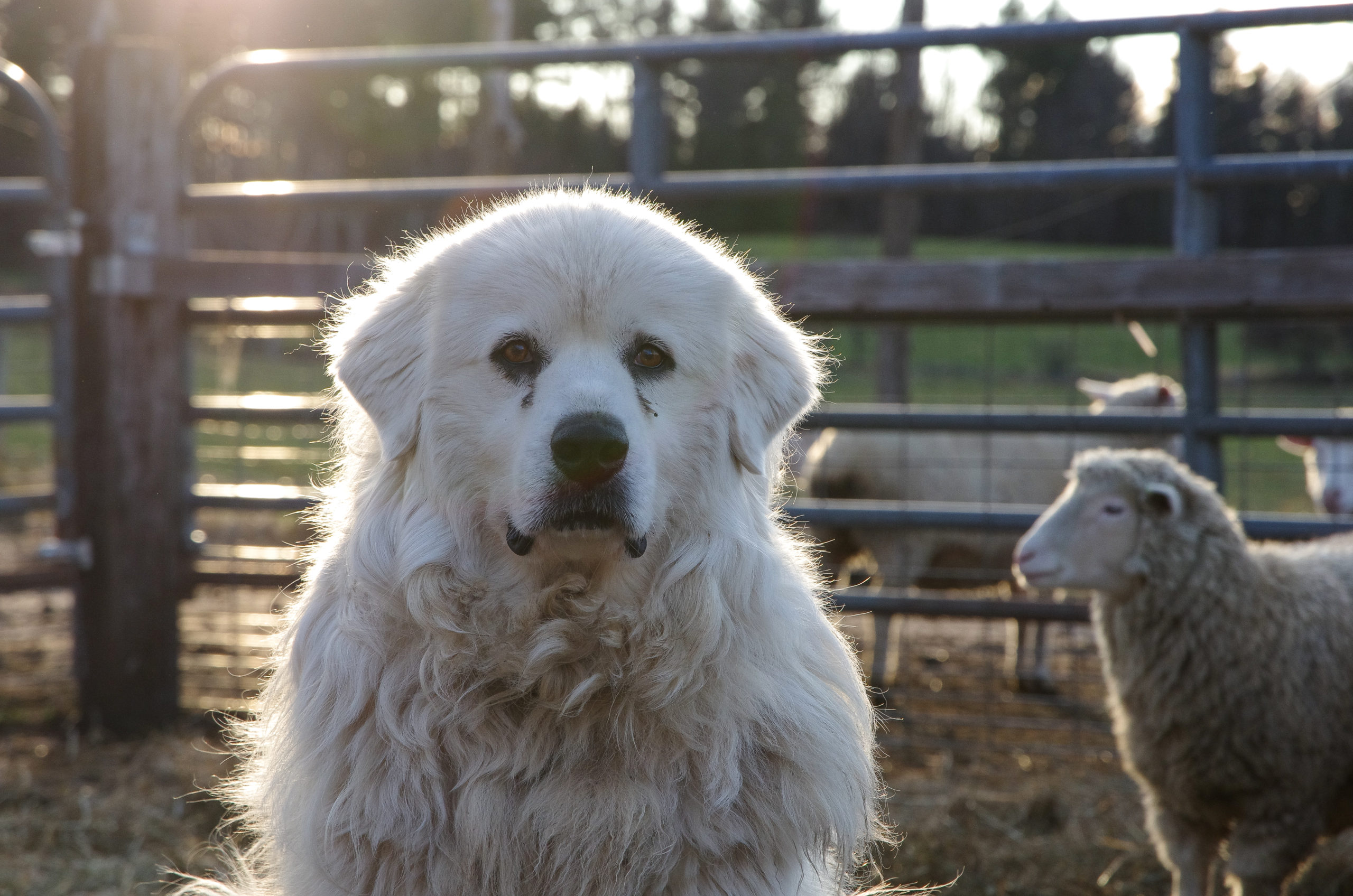 Even if every commercial sheep producer were to use LGDs, there would still be a surplus of dogs – dogs that don’t exhibit responsibility, dogs that have the “wrong” disposition for the circumstances. There would still be people who may have never seen a live sheep, but want to own a LGD for reasons of their own. (Witness the number of people who don’t hunt, but own Golden Retrievers.) So it becomes our responsibility, as owners and breeders of a large guardian breed, to recognize that behaviors that once were useful may now be liabilities. If we are considering breeding, we must ask ourselves the big “WHY” – Why am I breeding? What do I hope to produce? Have I studied enough individuals of this breed to really understand their behavior? Is it possible for me to spend enough time educating would-be buyers about those behaviors – and turn down those that I don’t feel really need this breed?
Rather than sidetrack ourselves into specious arguments – type-vs-soundness, show-vs-working, inbreeding-vs-outcrossing – we need to take an unbiased look at the realities presented in our society. We need to pay attention to the anti-dog legislation making its way into our communities, and start to educate ourselves as well as the public about the responsibilities of dog ownership in general and LGD ownership, in particular. If we don’t, we have only ourselves to blame when we find our beautiful guardians legislated out of existence.
Biography of Catherine de la Cruz: I have owned and bred Great Pyrenees dogs for over 30 years; I also raise sheep (in fenced pastures.) My present show dog is of my own breeding; he has five generations of OFA-clear dogs behind him; he and his entire litter cleared OFA Good or Excellent. He spent his first three years in the pasture, taking responsibility for a large band of purebred sheep. I bathe him on Friday night, bring him into the house (which he respects as “my” territory, so doesn’t raise a leg to mark it), show him on the weekend, then return him to his sheep Sunday evening. He is protective in the field, friendly at the shows. He is an example of what I consider to be a Livestock Guardian Dog for today’s times.